
Dunnage trays—also referred to as assembly trays, shipping trays, or handling trays—play a critical role in protecting parts, improving efficiency, and supporting automation. However, when tray design is treated as a late-stage decision, it often leads to costly redesigns and performance issues.
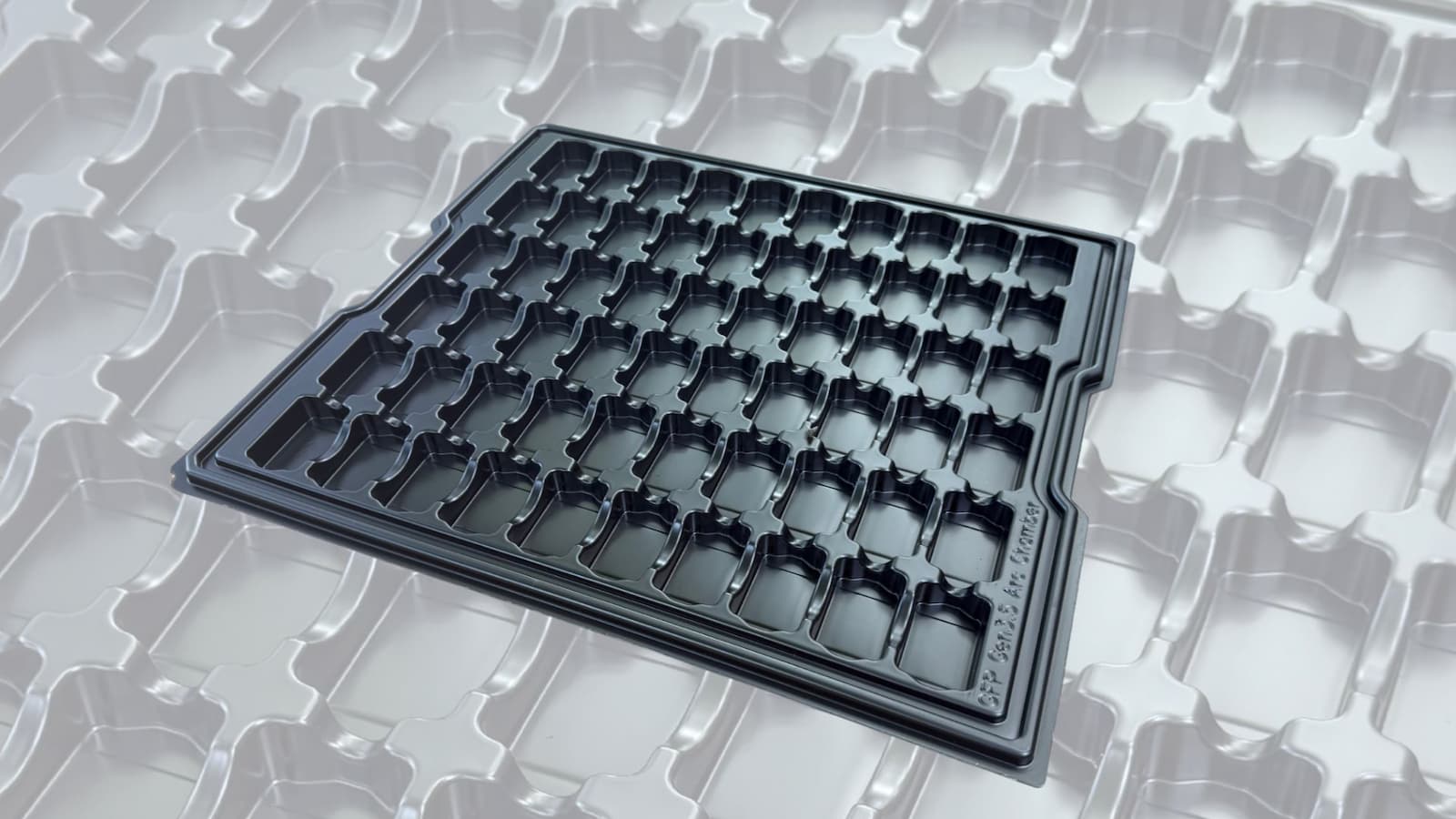
Above: ESD thermoformed dunnage tray safely transports sensitive electronics
Key Design Inputs for Dunnage Trays
In many manufacturing environments, thermoformed dunnage trays are developed after product design and primary packaging decisions have already been established. While this approach may seem efficient, it often introduces challenges later in the development process. In practice, treating dunnage trays as a late-stage packaging decision is one of the more common sources of avoidable redesign.
When designing a dunnage tray, several critical factors should be defined early in the process:
Product geometry, tolerances, and surface characteristics
Packaging constraints, including container size and bagging requirements
Desired part density and shipping configuration
Part orientation and handling requirements
Automation and material handling considerations
Structural performance and material selection
Dunnage trays are not simply protective packaging components. They function as part of a broader material handling and manufacturing system, influencing product protection, transport efficiency, automation compatibility, and overall cost. When key design inputs are not clearly defined at the outset, these factors tend to surface later as revisions, delays, or performance limitations that are more difficult to resolve once production is underway. Effective tray design begins with a clear understanding of the application requirements—not just the geometry of the part.
How System Constraints Influence Dunnage Tray Design
In most applications, dunnage tray dimensions are not driven by the product alone—they are driven by external constraints. These may include container specifications, product density, shipping configurations, bagging requirements, and handling considerations. Because these variables are interconnected, a change in one area often affects others. For example, the introduction of single or double bagging reduces available space within a container and can require adjustments to tray size or part density. For this reason, tray design is most effective when approached within the context of the full packaging and logistics system, rather than as an isolated component.
Why Accurate Product Data Is Critical for Dunnage Tray Design
Accurate product data is essential for developing a reliable thermoform tray design, but nominal dimensions alone rarely capture real-world conditions. Variability between part tolerances, product weight, and surface characteristics all influence how a product behaves within a dunnage tray. Access to both 3D model data and multiple physical samples allows for more accurate validation and helps ensure consistent performance across production conditions.
Balancing Part Density in Dunnage Trays Without Compromising Performance
Maximizing part count per tray is often a key objective, particularly when shipping efficiency is a priority. However, increasing density introduces tradeoffs that need to be considered early. Higher density can impact the structural performance of the dunnage tray, especially in thinner gauge materials. In many cases, it becomes less about maximizing part count and more about balancing density with functional performance. Establishing that priority early helps guide the design in a more practical direction.
How Part Orientation Impacts Dunnage Tray Performance and Handling
Part orientation within a tray directly affects stability, handling, and downstream processing. It influences how parts behave during transport, how loads are distributed in stacked configurations, and how easily parts can be accessed. In some applications, orientation must also maintain a defined sequence between cavities to support assembly or inspection processes. When orientation is not clearly defined early, it can create conflicts later as additional requirements are introduced.
Stacking Methods for Dunnage Trays: Nesting vs. Stack-and-Rotate
Stack and rotate designs provide clearance between the top of the product and the bottom of the tray when stacked directly on top. This clearance offers product protection as the load of the thermoformed tray is carried on its exterior. Nesting trays, on the other hand, are designed to sit directly on top of the loaded tray beneath. The method of load transfer, whether through the tray structure or the product itself, must align with the product’s durability and the intended use conditions.
Designing Dunnage Trays for Automation and Material Handling Systems
When dunnage trays are used in automated systems, design requirements become more defined. Factors such as gripper type, pick locations, and required clearances need to be clearly understood. Thermoformed components inherently include variation due to forming tolerances, flange registration, and material behavior. Because of this, using perimeter edges or die-cut features as reference points for automation is not always reliable. Integrating locating features into the formed geometry of the tray typically provides more consistent results, particularly in areas of the tray that are less susceptible to variation.
Establishing an Effective Tolerance Strategy for Dunnage Trays
Not all dimensions within a tray require the same level of control. Functional features—such as part retention, alignment, and automation interfaces—should be prioritized when defining tolerances. Applying tight tolerances to non-critical features can increase manufacturing cost and inspection requirements without improving performance. A more targeted approach helps maintain both efficiency and functionality without introducing unnecessary complexity.
Challenges of Reverse Engineering Existing Dunnage Trays
When working from an existing dunnage tray, it is common to request replication of the original design. However, without understanding the intent behind that design, this approach can introduce limitations. Thermoformed parts are not perfectly repeatable, and reverse engineering alone may not capture all functional requirements. Evaluating how and why the tray was designed, and aligning it with current application needs, often leads to a more effective result than attempting to duplicate it exactly.
Why Early Design Inputs Determine Dunnage Tray Performance
Thermoformed dunnage tray design is most effective when it is approached as part of a larger system rather than an isolated component. By clearly defining system constraints, product characteristics, handling requirements, and automation considerations early in the process, engineering teams can develop solutions that are more efficient, reliable, and scalable. In many cases, the success of a tray design is determined less by the final geometry and more by the quality of the inputs established at the beginning of the project. When those inputs are incomplete, the resulting challenges rarely disappear—they simply become more difficult and more costly to address later.
At Dordan, we work with engineering teams to develop custom thermoformed dunnage trays optimized for protection, automation, and cost efficiency. If you’re evaluating a new tray design or redesigning an existing one, our team can help guide the process from concept through production.